Four countries. One price shock. A market in turmoil.
Within just a few months in early 2025, cocoa prices climbed to over 12,000 US dollars per ton, a 150% increase compared to the previous year. This explosion was driven primarily by poor harvests in West Africa, where the Ivory Coast alone accounts for roughly 44% of global cocoa production.
One country, one bad weather year, and the entire global confectionery industry felt the pressure. By February 2026, prices had fallen back to around 4,200 US dollars, near the lowest level since January 2024. This rollercoaster illustrates exactly what happens when a market is too heavily concentrated on just a few origins.
Why Latin America Is the Right Answer
For manufacturers relying on fine cocoa from Venezuela, Colombia, Ecuador, Peru, the Dominican Republic, or Panama, this exact concentration presents an opportunity. These countries face different climatic and political risk factors than West Africa. Broadening a portfolio within this region reduces dependence on any single harvest, without having to switch continents or move away from the origins that existing recipes and quality standards were built on.
The Parameters That Really Matter
Switching origins within Latin America sounds simple, but it is never just a price comparison. Four key characteristics determine success or failure:
Flavor profile: Sur del Lago from Venezuela delivers a well rounded chocolate taste with notes of butter, hazelnut, and red berries. Guasare, on the other hand, brings a nutty aroma with caramel and subtle cherry tones. Tumaco from Colombia stands out with an intense chocolate note and fruity undertones. Three countries, three completely different sensory profiles.
Fat content and melting behavior: Cocoa butter content and melting point vary depending on origin and processing, with a direct impact on texture and mouthfeel.
Color: Fermentation level and roasting determine the brown tone, which is critical for color sensitive applications.
Processing characteristics: Particle structure and viscosity influence grinding behavior in production.
Each of these values must be checked against the existing specification before a new origin is even considered.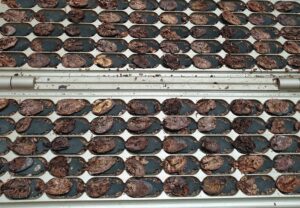
Approval Instead of Guesswork
A new origin should never enter ongoing production untested. Sample delivery, laboratory analysis, sensory comparison against the reference quality, and a controlled trial run are all part of the standard process. Only once every characteristic falls within tolerance does approval follow.
Blending as a Gentle Transition
Rather than abruptly replacing a proven origin, a gradual approach works better. The new quality is initially blended in at small ratios while flavor and technical values are continuously monitored. This builds a second or third supply source without anyone noticing a difference in the finished product.
The Advantage of a Broad Network
Manufacturers who already have several approved origins in their portfolio can respond to supply shortages in days instead of weeks. Bohnkaf trades cocoa beans from Venezuela, Peru, Ecuador, Colombia, the Dominican Republic, and Panama, each with clearly defined sub-regions and qualities. This breadth within the Latin American core market makes it possible to find a matching alternative for almost any existing flavor and quality profile, guided by expert support from the first sample delivery through to a production ready substitution.
Bottom line
The next price shock is coming, it's just a question of when. Manufacturers who broaden their supply chain within Latin America are ready for it, without compromising on flavor or quality.
